


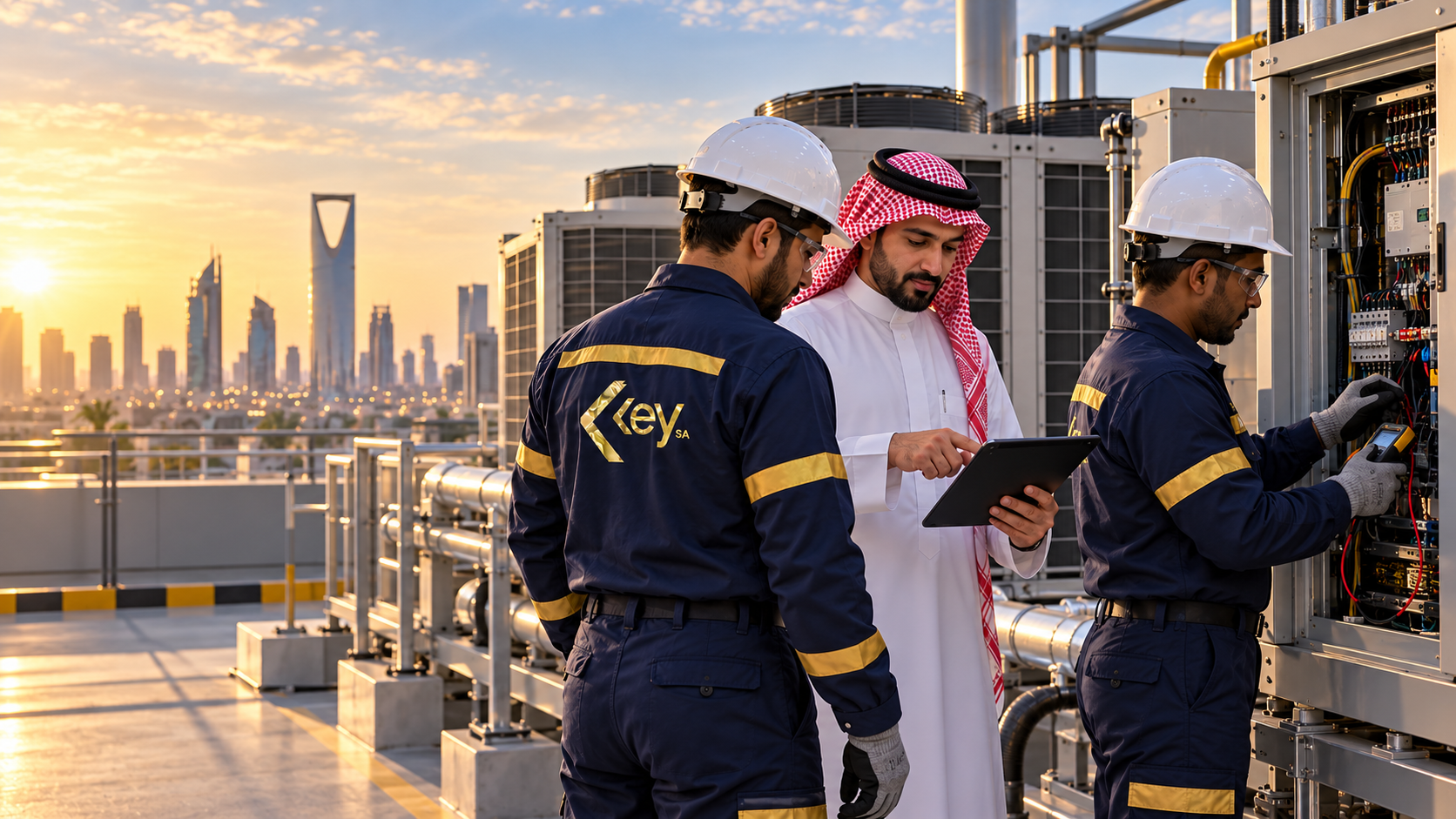
Facilities maintenance services in Saudi Arabia help organizations keep buildings safe, reliable and ready for daily operations. In a climate where cooling systems, electrical infrastructure and water systems can operate under sustained demand, maintenance cannot be limited to repairing equipment after it fails.
A dependable programme combines planned maintenance, inspections, condition monitoring, responsive repairs and performance reporting. The aim is to control operational risk, extend asset life and reduce avoidable disruption while maintaining a safe environment for employees, customers and visitors.
What Are Facilities Maintenance Services?
Facilities maintenance services include the technical and operational activities required to preserve a building and its installed assets. The scope may cover mechanical, electrical and plumbing systems, heating and cooling equipment, fire and life-safety assets, lifts, building fabric, lighting, water systems and specialist equipment.
Maintenance is one part of the wider facilities management services model. It works alongside cleaning, security, workplace services, energy management, health and safety, supplier control and performance governance.
Why Maintenance Planning Matters in Saudi Arabia
Saudi facilities may experience high ambient temperatures, dust, extended cooling demand and intensive equipment use. These conditions can accelerate filter loading, affect heat transfer, increase electrical demand and place additional stress on mechanical components.
Maintenance strategies should therefore be based on actual site conditions rather than generic schedules alone. Asset criticality, manufacturer guidance, operating hours, environmental exposure, failure history and regulatory requirements should all influence the frequency and method of maintenance.
For critical facilities, a single failure may interrupt business operations, affect occupant safety or damage sensitive equipment. A structured programme helps identify these risks before they become costly incidents.
The Main Types of Facilities Maintenance
1. Preventive Maintenance
Preventive maintenance is completed at planned intervals to reduce the likelihood of failure. Examples include inspecting electrical panels, cleaning HVAC coils, replacing filters, testing emergency systems, lubricating moving components and checking water pumps.
The schedule should be reviewed regularly. Tasks that produce no useful result may need adjustment, while assets with repeated failures may require more frequent inspections or a different maintenance method.
2. Corrective Maintenance
Corrective maintenance restores an asset after a defect has been identified. It may be planned after an inspection or performed urgently following a failure. Clear priorities and escalation rules help ensure that safety-critical and business-critical faults receive immediate attention.
Repeated corrective work on the same asset should trigger root-cause analysis. Continually treating the symptom can increase cost without solving the underlying problem.
3. Condition-Based Maintenance
Condition-based maintenance uses inspections, readings or sensor data to determine when intervention is needed. Temperature, vibration, pressure, energy consumption and equipment alarms can reveal changes before complete failure occurs.
This approach is most useful when the data is reliable and the response process is clear. An alert has little value unless it reaches the responsible person and leads to documented action.
4. Predictive Maintenance
Predictive maintenance applies trends and analytical models to estimate potential failure. It can support better planning of labour, spare parts and shutdowns, particularly for important equipment with measurable operating patterns.
As explained in KEY FM’s guide to smart facilities management in Saudi Arabia, technology is most effective when it strengthens sound operational processes rather than replacing them.
A Practical Maintenance Workflow
A controlled workflow ensures that each maintenance activity can be assigned, completed, checked and reported. A typical process includes:
- Identify: Register the asset, fault, inspection finding or scheduled task.
- Assess: Determine safety, operational and service consequences.
- Prioritise: Apply an agreed response category and target time.
- Assign: Allocate competent personnel, tools, materials and permits.
- Execute: Complete the work using approved procedures.
- Verify: Confirm that the asset is safe and operating correctly.
- Record: Capture labour, parts, readings, findings and evidence.
- Review: Analyse recurring faults, overdue work and improvement opportunities.
Critical Systems Requiring Consistent Attention
HVAC and Indoor Environmental Systems
Cooling and ventilation are central to building performance in Saudi Arabia. Maintenance should address filters, coils, fans, belts, refrigerant conditions, controls, condensate drainage and air distribution. Poorly maintained systems may consume more energy while providing weaker comfort and air quality.
Electrical Infrastructure
Electrical inspections may include panels, protection devices, connections, backup power, batteries, lighting and distribution equipment. Work must be completed by competent personnel using appropriate isolation and safety procedures.
Plumbing and Water Systems
Pumps, tanks, valves, drainage, fixtures and water-treatment components require planned checks. Early detection of leakage, pressure changes or abnormal consumption can prevent property damage and unnecessary resource loss.
Fire and Life-Safety Systems
Fire alarms, suppression systems, emergency lighting, exit systems and related assets must be maintained and tested according to applicable requirements. Records should clearly show what was tested, the result, any defect found and the corrective action taken.
Using CAFM to Control Maintenance
A Computer-Aided Facilities Management system can connect asset registers, preventive schedules, service requests, work orders, stock information and performance reports. Mobile access allows technicians to receive tasks, record findings and attach evidence while working in the field.
However, software quality depends on data quality. Asset names, locations, task frequencies and priority rules must be accurate. Regular data checks are necessary to prevent duplicate assets, missed tasks and misleading reports.
Maintenance Performance Indicators
Useful maintenance indicators should help management understand reliability, risk and delivery quality. Common measures include:
- Planned maintenance completed on time
- Emergency and reactive work as a percentage of total work
- Average response and resolution times
- Repeat failures and reopened work orders
- Critical overdue tasks
- Asset downtime and service interruptions
- First-time fix rate
- Maintenance cost by asset, system or location
- Safety observations and corrective-action closure
Metrics should support decisions, not simply fill dashboards. Each measure needs a clear definition, reliable source and accountable owner.
How to Choose a Maintenance Service Provider
Organizations should evaluate whether a provider understands their asset types, operating risks and required service levels. Review technical competency, safety management, mobilization planning, supervision, emergency coverage, spare-parts control, reporting and technology capability.
The provider should also explain how it will verify completed work and improve performance over time. Transparent reporting, accessible records and regular operational reviews are essential for building trust.
From Reactive Repair to Reliable Operations
Reliable facilities maintenance is not achieved through isolated repairs. It requires accurate information, competent people, safe processes, suitable technology and consistent management attention. When these elements work together, organizations can reduce disruption, improve asset performance and make lifecycle decisions with greater confidence.
KEY FM supports clients through hard and soft services, integrated facilities management, asset and risk management, sustainability and energy management, technology integration, and quality and safety. To discuss a maintenance model suited to your buildings, contact KEY FM Saudi Arabia.